Keeping the Streak Alive
Click here for the TL;DR
Why do we care so much about keeping a streak alive? Streaks trick our brains through reification (treating an abstract count as a physical object), loss aversion, and identity shifts. To harness streak dynamics without letting the counter control you: make the minimum daily action absurdly easy (e.g., “open the laptop”), move your goalposts to upcoming milestones, redefine your internal “why,” and occasionally break a streak on purpose to maintain your personal agency.
I didn’t feel like blogging this week. Maybe I’m still in vacation mode. Maybe I’ve had such an intense period of growth I need to just simmer for a bit. Maybe it’s the darkening of the days and the chilling of the air.
I seriously contemplated skipping this week and breaking my streak of 239 weeks in a row. That’s 4.59 years. It’s a major decision to intentionally break a streak like that. I mean, c’mon… five years is within reach!
All that waffling got me curious about streaks, why we care about them, and how to harness the power they give you.
Streaks Capture Our Imagination
We’ve acknowledged streaks since—well, probably since before recorded history—but their effect really hit the common awareness with the launch of Wordle. Suddenly, millions of people were talking about keeping their daily streak alive.
Streaks are also celebrated in sports, of course. I lived near De La Salle high school when their 151-game winning streak (still the national record) was broken. The seniors on the team that lost the streak were just starting kindergarten when the streak began.
Then there’s the remarkable 98-game winning streak by the Cal rugby team. I heard coach Jack Clark speak at an alumni event not long after that, and someone asked him what he told the players after that loss in the 99th game. He answered, “I just said, ‘Tough loss, lads. Tomorrow we start winning again.’”
Looking back, we think wow that streak must have been something to have been a part of. And when the streak is over, it’s history. But while it’s going on, it has a power that can be harnessed.
Why Streaks Feel So Meaningful
Once a streak gets going, a number of things happen that give it extra meaning. Here are three that I think are particularly important:
1. Reification and Loss Aversion
When you do something a few times in a row, at first it might be an amusement. A curiosity. A score to monitor.
After a time, however, our brain stops thinking of the streak as a measurement and starts thinking of it as a thing. Instead of “I did this nine days in a row,” we start thinking “my streak is nine days.” This is called reification—assigning a concreteness to an abstract thing.
So now there is this thing (your streak) which has no physical form or market value but which feels very real. Even more important, the streak becomes not just a thing, but a thing you own.
Even just saying my streak assigns ownership. This is when the endowment effect takes over. We assign a higher value to something we own than that exact same thing we could acquire. My Mazda CX-5 is more valuable to me than any other Mazda CX-5 in the world, even the thousands that are in better condition. My current streak is more valuable than any theoretical future streak.
Then, when you have this very valuable thing that is yours, loss aversion kicks in. We feel the fear of loss more strongly than the anticipation of gain. That is, we’re motivated to hold on to the things we own.
Breaking the streak will mean losing this thing we have ownership of.
None of this seems rational when you think deeply about it. A streak is not actually a thing. It has no market value. And you can always start a new streak. But this is how our brains work.
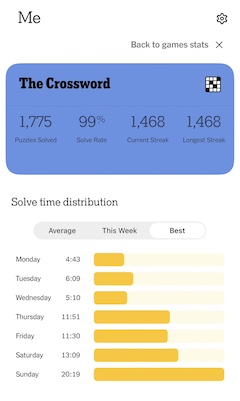
My 1,468 day streak of solving the daily New York Times crossword puzzle is not a thing. It has no actual value. But I would hate to give up that streak. (So much so, that on about 40 of those 1,468 days I cheated a little bit. And I’m okay with that.)
2. Sunk Cost Fallacy
Early in a streak—before we identify it as a streak—we don’t care much about keeping it going. We haven’t invested that much, and it will be easy enough to get back to where we are if the counter resets to zero.
Take Wordle. How much do you care about doing today’s puzzle if your streak is three days? How about 13 days? How about 113 days?
Or this blog. Early on, I dedicated myself to creating a new habit, so I made sure I did one post every week until that habit set in. Then it became a streak. When I had, say, 20 posts written, I had proved to myself that I could post weekly. But I wasn’t deeply committed to the streak itself. I could easily get back to 20 weeks in a row, if I missed one.
Now, however, at 239 posts, I can see the 250 post mark is within reach. And it would take a long time (4.59 years!) to get back to where I am now if I let the counter drop to zero.
The sunk cost fallacy is where we tell ourselves we need to keep going because of how much we’ve already invested.
But in reality? There is no real value in keeping this streak alive. Nothing much will change if I skip one week. I wouldn’t lose any clients. I wouldn’t lose any book deals. I wouldn’t lose any sleep. I imagine if I missed a week and asked Jack Clark for inspiration, he’d tell me, “Tough week, lad. Next week you start blogging again.”
3. Identity Shift
At some point when your streak is long enough, you can experience a subtle shift in your identity. You move away from “I am a person who enjoys exercising” to “I am a person who exercises every day.”
The idea of breaking the streak begins to feel fundamentally threatening. How can I be a person who exercises every day if I do not exercise this day?
Any threat to identity is a powerful motivator. So it becomes harder and harder to intentionally break a streak the longer the streak goes on, and you don’t even understand why. Sometimes the streak itself becomes an albatross around your neck, a burden you must carry because it is part of who you are now.
Using Streaks to Build New Habits
If you want to start doing something with regularity, you can exploit these streak dynamics to create the new habit.
Everyone I know has something they have wanted to start doing regularly. Some of these are lifestyle changes (exercising five times a week, writing every day). Some are situational that require a diligence and discipline for a time (applying for jobs).
A lot of people start but then fall off before the new practice becomes a true habit. And in fact, the thing may never become a habit at all. It may take intention to keep going, even when you have strong momentum. Like this weekly blog.
Here are my tips on using streak dynamics if you want to create a new habit.
1. Start with an Intentional Commitment
Starting a new streak takes energy and commitment. You will need to focus extraordinarily hard on discipline during the first few weeks of this new pursuit. Don’t worry… you won’t need to force yourself to have this discipline forever. As it turns out, the streak dynamics start to show up after about eight days. After four to eight weeks, your reward center will shift from feeling good about doing the activity to feeling good about keeping the streak going.
2. Make the Streak Easy to Keep Alive
One of my clients wanted to write for one hour every day. She did okay for a while, but some days were less cooperative. Then she would miss a day. One missed day would turn into two, and then three, and slowly her streak of days writing turned into a streak of days not writing. That is not what she wanted. So we reset her daily goal. She still wanted to write for an hour every day, but instead of her streak being based on “an hour of writing completed,” we changed it to “laptop opened.” She could absolutely open her laptop every day and keep that streak going indefinitely. What she discovered was that she ended up writing something nearly every day, and she was even completing the full hour more days than she had before. Now she’s feeling good about herself even though she doesn’t complete that hour every day.
3. Move the Goalposts on Purpose
When you’ve got a streak going, look for the next milestone and shoot for that. I’m only 11 posts away from 250 weeks in a row. I’m less than six months away from five years of weekly blogging. These are achievable goals if I keep my streak going. Sometimes this can help make up for a lack of motivation. It also keeps the motivation on the positive side (goal to strive for) instead of the negative side (avoid losing the streak).
4. Change What You Value About the Thing
To keep this blog streak going, I have redefined my “why” several times. It started as a way to introduce me and my thoughts to the world. Then it became a way for me to market myself. Ultimately, it has become a way I learn and process. In writing this post, for example, I researched streak dynamics and learned some interesting new facts I did not know before. This reinvigorates my intrinsic motivation to put out a blog post every week, making the streak seem more worth continuing. I know that I will get value from every post I write, even if no one else ever reads it.
5. Intentionally Break the Streak from Time to Time
When you lose a streak unintentionally, it can feel like a major setback. Resetting that counter to zero, especially if you’ve been watching it climb to amazing heights (really, what high school football team can win 150 games in a row?!?), can be a gut punch. Some people never recover and just move on to something else. Breaking a streak intentionally, however, through a positive decision to reset that counter to zero, can give you a renewed feeling of agency. It can give you power over the counter rather than letting the counter have power over you. And it can reset your identity to a healthier place. One friend of mine never lets her Wordle streak get larger than 20. When it does, she skips a day on purpose.
What Habit do You Want to Start?
I bet you’ve got an activity you would like to turn into a daily or weekly practice. What’s getting in your way? How can you gamify your life to install streaks or other gimmicks that will help get you started, then keep you going? Let’s talk it through.
I help people make the most of every day. I help people live creatively, lead confidently, and care courageously. I am no wiser or smarter than the ancient gurus and sages, but I am a skilled and experienced practitioner of synthesizing all that wisdom into a version that is most useful to the person sitting across from me. That’s a skill based on innate talent, perpetual study, thousands of hours of practice, and a long, deep, rich life of diverse experiences.
If you want to tap into that and let life wash over you, grab time on my calendar. Let’s talk.
Book us for Your Workshop
We would love to do our workshops for your team, staff, conference, or other group. We can build a custom workshop for your needs, on topics from nonprofit board development to powerful communications to overcoming burnout.
Over the past several months, our two most popular workshops have been
- Overcoming Compassion Fatigue
Compassion fatigue and burnout can affect everyone. We help individuals become more resilient and capable of avoiding and overcoming compassion fatigue. We help teams improve their culture and habits to reduce burnout. And we help leaders learn what causes burnout and compassion fatigue and how they can protect their teams from it while giving them the support they need. - Flourishing Through Caregiving
Caregiving is one of the hardest things any person can be called on to do, but it can also be filled with beauty, meaning, and purpose. Without getting sanctimonious or leaning on toxic positivity, we help individuals and families take on a caregiving responsibility without unnecessarily sacrificing their careers, their own health, their relationships, or their identity along the way. Centered around our Three Cs of Caregiving, this workshop covers aspects of project management, clear communication, team culture, personal resilience, and learning to be in control of your emotions instead of governed by them.
For more information, drop me a line with what you’re interested in, or just book an exploratory call on my calendar now.
Other Things to Do
Download a free chapter from one of my books. Or just buy the whole book now. You probably will after reading the free chapter anyway, so why wait?
With Take Your Time Before Time Takes You, learn to make the most of every day through thought-provoking exercises and perspective-twisting stories. Get it now in paperback or ebook, or download the introduction now for free.
“It changed my life.” – TP, client
“A go-to guide for people who want to improve their lives but don’t know where to start.” – MJ, earlier reviewer

RELIT: How to Rekindle Yourself in the Darkness of Compassion Fatigue gives practical, actionable advice on avoiding and overcoming compassion fatigue and caregiver burnout. My chapter explains how I stay centered and focused so I can give every client my best, every time.
Download my chapter for free: Show up. Try hard. Be nice.
Or just go buy the whole book. It’s worth it.