How Unconscious Strategy Causes Friction
Click here for the TL;DR
Everyone operates on a strategy, whether written down or purely unconscious. Strategy sits at the intersection of Desire (what you want), Perspective (how you view the world), and Action (what you actually do). Interpersonal conflict (like co-founders disagreeing on business growth) usually happens when two people share the same desire but execute through colliding unconscious strategies. To get better outcomes, you must track actual behaviors and intentionally change your underlying desire, environment, or perspective.
Everyone goes through life executing on a strategy, though most of us don’t think of it that way.
Strategy is simply how you make decisions, whether those decisions are conscious or not. Strategy does not have to be intentional or written down. You do not have to be aware of it for it to be in effect.
The actions you take reflect the strategy that drives you. The actions others take reflect the strategies that drive them. And they may be entirely unaware they have a strategy.
This may seem like I’m simply defining strategy in a kind of intellectual “look how smart I am” exercise. (I am prone to do that. I want you to think I am clever and witty.) But this is actually really important because even the smartest people do baffling and frustrating things. And we, in our turn, do things that baffle and frustrate others.
That frustrating bafflement causes tension in any relationship (both personal and business). We focus on the decision that was made and how knuckleheaded it seems. And our cognitive engagement ends there.
But dig underneath the “why” of the decision and get at the strategy that led to it, and you have at least a shot at overcoming the tension and making decisions that everyone understands.
The Strategy Equation: Perspective, Desire, and Action
If strategy drives decision-making, then what makes up a strategy?
Strategy exists at the intersection of perspective, desire, and action.
Strategy is the application of perspective to desire, resulting in action. That is, you want something (desire). You look at the world as you understand it (perspective), and you predict the best way to get the thing you want (action).
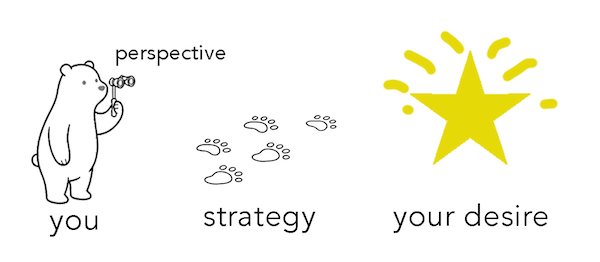
All this can happen consciously, as when an organization creates a written strategic plan to grow, or it can happen unconsciously, as when an employee works unpaid overtime to earn a promotion.
Understand that you are executing on a strategy even when it feels like you’re just “doing the obvious thing.” To someone else, doing the “obvious” thing may look like insanity, even if you both have the same desire.
Take two people who want to get promoted, for example. One might think that the obvious way to promotion is to work harder than everyone else and make the job look effortless. The other might think the obvious way to promotion is being social and outgoing, forming a good relationship with the boss.
Those two approaches reflect a difference in strategy, which in turn reflect a difference in perspective.
Each person thinks the other is nuts. One of them will earn the promotion, leaving the other baffled and frustrated. Or maybe neither gets promoted, and they both end up resentful and cynical about the whole process… and the boss doesn’t understand why.
When a Strategy Causes Friction – A Real World Example
Building a business is hard. Antoinette and I are building Gray Bear Advisors together, and although we’re having success and making progress, we have big aspirations.
We collaborate well and are aligned on a lot of things. But there’s one aspect of our collaboration that has been frustrating to us both, until recently.
This friction came up last month when I booked us to guest-speak (for free) to a small, local group. When Antoinette asked what we would get out of it, my answer was that I didn’t really know, but something interesting might come of it. She viewed this as a waste of time and energy, and we needed to be more discerning about what we said yes to. We were both judging the action I took through different perspectives.
People experiencing this kind of friction often end up with “well I guess we just can’t work together” because they never dig under the surface to understand the different strategies in action, and the underlying perspectives that lead to those strategies.
Fortunately, I got some very good coaching from one of my colleagues in this year’s LTV cohort, which led to an epiphany of sorts. I was already partway there myself, but the coaching made it very clear.
Our conflict boiled down to a difference in our unconscious strategies: I prefer to cast 10,000 seeds and see what blooms. Antoinette prefers to be intentional and laser focused about which seeds to nurture. (I say unconscious strategies because before this, I don’t think either of us was fully aware that a strategy was driving our actions. I just said yes to too many things she didn’t see much value in.)
Neither strategy is bad, but they collide in some important ways. And until we understood that collision, we judged each other’s actions as being counterproductive.
When I realized that her strategy was focused nurture, I instantly understood how having me strew 10,000 seeds could feel overwhelming and distracting. When she saw my strategy was to expand possibility with fewer limitations, she understood how I might feel restricted and stifled by saying no more often.
Now we can both make decisions that take into account our two strategies. We can also more quickly intercept frustration before it turns into something bigger, and diagnose it easier so we can move forward in a positive way instead of stew in frustration. We can also both interrogate our strategies for any decision, and decide if we want to use a different one instead.
This might seem super obvious to a third party (it seems pretty obvious in hindsight), but when you’re in the middle of a conflict between two unconscious strategies, it’s almost impossible to see. That’s because the strategies derive from the different perspectives each person is applying, and just like you can’t see your own face without a mirror, you can’t discern your own perspective without some kind of reflective view. Like my colleague provided me.
Five Steps to Uncover Your Unconscious Strategy
Strategy derives from the application of perspective to desire. When you want something, you apply your worldview to predict the best way to get that thing.
There are several ways to understand your unconscious strategies:
1. Keep track of your actual behaviors
Everything you do involves a choice. Even if you flip a coin to make a decision, your choice was to flip a coin. What strategy led to the belief that flipping a coin would be the best path to getting what you wanted? Even more important, how often does this strategy show up in your actual behaviors? Track the actions you take and look at the trends without judgment. The trends reveal the strategy that is driving you.
2. Compare your behaviors to your conscious strategy
The strategy that is driving you may or may not match the strategy you think you are pursuing. If you say you’re going to pursue big contracts but always find yourself in small gigs, then your unconscious strategy is winning. (Pro tip: the unconscious strategy always wins.) The point here is to understand that failing to follow the conscious strategy you say you want is not a personal failing or a lack of moral fortitude. It’s just that you’re actually following a different strategy. You can then decide if you want to embrace that unconscious strategy and lean into it, or change it.
3. Challenge your beliefs about other people’s actions
Every time you find yourself baffled by someone else’s decision, pause. Take a moment to try to figure out the strategy underlying that decision. It’s too easy to write other people off as ignorant, wrongheaded, or self-defeatist. But your bafflement is caused by one of two things: A misunderstanding of what that person desires, or a perspective and worldview so different from theirs that it creates a completely different map. Use this analysis on yourself, especially when someone else finds your decisions baffling.
4. Articulate the many dimensions of your worldview
We are all complicated people, with countless dimensions that shape how we experience the world. I am a straight, white, middle aged man from a Euro-American and agnostic background who grew up in Connecticut, is college educated, has divorced parents who are both still alive and healthy, and who has two adult kids. Those are only a few of the most obvious dimensions that shape my worldview. I might throw in that I’m an entrepreneur, that I’ve been laid off three times, that I speak English but understand a lot of Spanish, that I’ve traveled to more than a dozen countries, that I used to play and coach soccer… How granular can you get in defining the dimensions of your identity? With each new level of granularity, consider how that might affect your internal unconscious strategy factory.
5. Explore your core values
Core values are another way of articulating the dimensions of your worldview. Instead of “where do I come from,” however, it’s focused on “what do I truly care about?” You can use my core values exercise (free download here) for this one.
How to Change Your Unconscious Strategy
If strategy derives from the application of perspective to desire, then there are really only three ways to change how your internal strategy factory works.
Every time you have a decision to make, your strategy factory fires up a strategy. You have a desire, and the strategy factory applies your worldview to that desire, and voila! You have a decision. This happens immediately in the subconscious for most things, and most of the time we don’t even perceive that we’re making a decision.
So, if you are tracking your actual behaviors and finding that they do not match what you would like them to be, the only ways to change your strategy factory are
1. Change the desire
If your behaviors aren’t moving you toward the thing you want, maybe you don’t actually want that thing. I see this all the time with people who tell me, “I’ve wanted to write a book for years.” There is always some excuse for why they haven’t completed it yet, and in my experience what they really desire may be something else. They desire the feeling of being admired for having written a book, perhaps, in the same way that I would love to be adored as a rock star yet haven’t gotten my acoustic guitar out of its case in years. So if your behaviors aren’t moving you toward the thing you want, spend some serious effort examining whether you really want something else, and how your existing strategy is actually providing that to you.
2. Change the world
If you are so dedicated to the strategy you’re using but it’s not having the desired effect, then you could try changing the world so that your strategy will work. This sounds fanciful, but people do it all the time. One example is getting divorced. Another example is hiring someone to accomplish the things you can’t do yourself. These are ways to preserve your strategy while changing the environment in which you apply it. This rarely works out in the end because we often end up either changing our world right back to what it was, or not changing the right aspects of the world because we’ve misdiagnosed the problem.
3. Change your perspective
If you feel like you’re never able to get what you want, maybe there is something in your worldview that is creating non-workable strategies. Perhaps you have some magical thinking—if I work very hard but don’t tell anyone how hard I’m working, the boss will appreciate me even more and give me a big promotion!—or perhaps your biases and fears are stopping you from capitalizing on opportunity, or pushing you in a direction that just won’t work—I will write a lot of blog posts so I don’t have to make sales calls! This is perhaps the hardest change to make because it requires getting some visibility into your own biases and prejudices, but you can’t see your own face without the aid of a mirror. Similarly, you can’t see your own biases without the aid of external perspective. If you can learn to see how you view the world through all your different lenses, you have a better shot at choosing which lenses to apply in any situation.
Get Intentional and Get What You Want
What is it you want that you’ve been unable to get? Connect with me to start building the right strategy today. Why wait? Putting it off to tomorrow is a choice. What unconscious strategy might underlie that choice?
Trying to build a strategic plan for your organization? Traditional strategic planning processes are good at creating beautiful descriptions of fictitious futures that never come to pass. That’s because they are about documenting desire. Let’s talk about how you’re building your strategic plan, and what you really want it to accomplish.
Email me at peter@graybearcoaching.com to start the conversation, or book some time with me now.
Other Things to Do
Download a free chapter from one of my books. Or, learn about workshops and trainings that Antoinette and I provide for your staff, board, or club.
With Take Your Time Before Time Takes You, learn to make the most of every day through thought-provoking exercises and perspective-twisting stories. Get it now in paperback or ebook, or download the introduction now for free.
“It changed my life.” – TP, client
“A go-to guide for people who want to improve their lives but don’t know where to start.” – MJ, earlier reviewer

RELIT: How to Rekindle Yourself in the Darkness of Compassion Fatigue gives practical, actionable advice on avoiding and overcoming compassion fatigue and caregiver burnout. My chapter explains how I stay centered and focused so I can give every client my best, every time.
Download my chapter for free: Show up. Try hard. Be nice.
Or just go buy the whole book. It’s worth it.