Stop seeing opponents where you have allies
Click here for the TL;DR
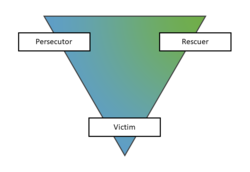
Most of our popular stories rely on a hero coming to rescue the victim. But that structure, while highly entertaining on the big screen, can create conflict and dysfunction in our daily lives. And still, we are so conditioned to need someone to blame, we find proxy perpetrators in our environment. We unwittingly step onto Stephen Karpman’s classic Drama Triangle (Victim, Prosecutor, Rescuer), causing unnecessary conflict and turning our own team members into perceived opponents. Stepping onto this triangle ends up creating conflict and tension, breaking down trust, and isolating us from those who we need to rely on. Emotional resilience requires moving away from the accusatory question “Who is to blame?” and actively adopting the collaborative question, “Who can help?”
When people feel like victims but can’t identify a clear perpetrator, we look around for somewhere to place the blame for our problems. In doing so, we make our own lives worse. (I talked about this in my recent interview about caregiving.)
For example, when someone gets diagnosed with dementia, the stressed-out caregiver can feel like a victim. Their life gets disrupted. Their time no longer feels like their own. The person they love is being taken away from them. All without their consent.
Why We Crave Someone to Blame
It’s unsatisfying to be a victim of circumstance, so we find a proxy to take the blame. It’s not intentional. It’s not personal. We just need someone to blame for what’s happening.
We get mad at the nurse who’s just doing his best. We get mad at the medical system for not having a cure. We get mad at our family members for not doing more to help. We get mad at the person with dementia for abandoning us.
Back in 1968, Stephen Karpman proposed a model for describing conflict-ridden human interaction. It’s called the Drama Triangle and is a staple of psychotherapy. You’ll recognize the drama triangle from most movies these days. There’s a victim, a perpetrator (the model calls it a “prosecutor”), and a hero (the model calls it a “rescuer”).
Popular Culture Conditions our Conflict Response
Every good story needs conflict, and the most accessible conflict is “perpetrator hurts victim.” With that conflict, the writers have three options:
- Perpetrator wins (unsatisfying)
- Victim overcomes (complicated)
- Hero rescues victim (satisfying)
We especially love the story where the hero rescues the victim. It’s simple, clean, and satisfying. No one wants a story where the perpetrator wins and goes unpunished. And, the story of the victim that gets revenge is complicated because revenge often requires the victim to embrace their inner perpetrator.
But when victim and hero are two different people, we as the audience have a chance to identify with both characters. We can identify with the innocence of the victim while distancing ourselves from their weakness, and we can identify with the courage of the hero while distancing ourselves from the violence of their retribution.
It all seems straightforward and virtuous, doesn’t it? A perpetrator hurts a victim, and a hero rescues the victim and takes revenge on the perpetrator. The Drama Triangle. Clean. Understandable. Simple.
Our Stories Condition us to Need a Perpetrator
In a lot of cases, however, bad things happen without a perpetrator to blame. A pandemic sweeps across the world. A hurricane rips through a city. Dementia besets an aging parent. Lightning causes a wildfire. The market crashes, causing a recession leading to layoffs at your company.
Right now, dear reader, you may be looking at each of those things and saying, “Yes, but the bad things that result from those incidents can be blamed on people who failed to plan or who did not execute their jobs properly.”
If that’s where your mind went, then you just made my point for me.
We are conditioned to blame someone for anything bad that happens. Sometimes we blame ourselves. Sometimes we spread blame across a group. Sometimes we pick out a specific individual to take the fall for everything we feel bad about right now.
In any case, blame must be placed. Not because we actually need someone to be mad at, but because we have powerful emotions that we don’t know how to deal with. We need to put them somewhere, or they’ll eat us alive.
The better answer, of course, is to develop your resilience, perspective, and self-actualization in order to handle those emotions yourself, without blaming someone else.
The High Cost of Misplaced Blame
Of course there are times when one person really is to blame for a bad thing that happens. A CEO makes a bad decision. A person drives drunk. Someone steals your wallet. Perpetrators do exist.
When your feeling of victimhood stems from circumstance or fate, however, indulging your desire to blame someone else will only end up hurting yourself. That mindset starts to make everyone involved look like an opponent instead of part of your team.
We start thinking like this: “A problem exists. It must be someone’s fault. Who could it be?”
Instead of like this: “A problem exists. It needs to be fixed. Who can help?”
An Example: The Caregiver’s Pivot From Isolation to Teamwork
An exhausted woman caring for her father with dementia visits him in the memory care facility where she recently moved him. Dad has been difficult lately, bills are piling up, work has become extra stressful. She’s worried she may get laid off soon, and it feels like Dad’s condition just seems to get harder week by week, with no end in sight. When she arrives, Dad complains that his water cup is empty and that he’s thirsty.
Dad is the victim, the daughter is the hero, and dementia is the perpetrator in this drama triangle. But the hero can’t take retribution against dementia, and at the end of this story dementia will prevail. Where can our hero get justice?
What happens next is up to our hero. How she chooses to see the situation, even in the midst of her stress and exhaustion, will determine how the story will unfold.

If she steps onto the drama triangle: Suddenly, the staff at the memory care facility become her opponents; they are the manifestation of the ethereal perpetrator. They represent dementia, and our hero sees them as the problem. Why did they let his water cup stay empty? In what other ways are they failing? She starts looking for and seeing evidence of their failings in everything—last week’s schedule is still up on the bulletin board, the blinds should be open but were left closed… clearly, the staff can’t be trusted.
“If you can get into the mindset where everybody is on my team… you won’t feel like you’re surrounded by opponents. You’ll feel like you’re surrounded by support.”
– Peter Dudley (quote from the podcast)
If she stays off the drama triangle: Instead of embracing and indulging her victimhood, our hero taps into her resilience and remembers that her father’s dementia isn’t the staff’s fault. They chose to work in patient care; they didn’t have to take this job. The job is complex and difficult, and they have many demanding patients. They are part of her team, and probably as exhausted as she is. Our hero fills the water cup and opens the blinds. She takes down last week’s schedule and puts up this week’s. She finds gratitude for the fact that her father is in a safe place with people she will need to rely on for quite some time.
De-escalating Conflict Across Corporate, Family, and Social Ecosystem
I’ve seen the drama triangle in effect in all kinds of settings. I’ve been a victim, hero, and even perpetrator in my life. Everyone has. Often, our role in a drama triangle isn’t visible to us until long after the conflict has passed and we can reflect on our role in it.
But when we feel like we’ve been victimized and there’s no clear perpetrator, we’re conditioned to find one. The fact that we live in an excessively litigious society doesn’t help (the number of “injury lawyer” billboards in some cities is staggering). Someone must be to blame. Someone must pay. When we do that, we often become not a rescuer but a perpetrator of harm on someone who does not deserve it.
It’s hard to maintain the poise and clear-headedness it takes to move out of victim mode when you’re in a stressful, exhausting situation. Practicing these skills and capabilities when you are not in high stress is the best way to be prepared. I’ve written about maintaining your poise when you’ve run out of patience, and you can download our 11 Paths to Personal Resilience.
If you feel like you’re surrounded by opponents, or if you’re having trouble disarming a conflict in your workplace, your family, or anywhere else, give me a call. Let’s talk through it.
My Books
With Take Your Time Before Time Takes You, learn to make the most of every day through thought-provoking exercises and perspective-twisting stories. Get it now in paperback or ebook.
“It changed my life.” – TP, client
“A go-to guide for people who want to improve their lives but don’t know where to start.” – MJ, earlier reviewer

RELIT: How to Rekindle Yourself in the Darkness of Compassion Fatigue gives practical, actionable advice on avoiding and overcoming compassion fatigue and caregiver burnout. My chapter explains how I stay centered and focused so I can give every client my best, every time.
Download my chapter for free: Show up. Try hard. Be nice.
Or just go buy the whole book. It’s worth it.



2 Comments
It’s Not Fair – Why so Many Caregivers Sacrifice Everything · August 3, 2026 at 4:33 pm
[…] could go into all the ways we look for something to blame when bad things happen, but I wrote about that a month ago, and that’s a different […]
Four Ways to be Heroic in a Caregiving Support Role · August 10, 2026 at 1:31 pm
[…] person may be falling into the Fairness Trap, or a truth like they are causing conflict by being unnecessarily confrontational, or a truth like it’s time for the person they’re caring for to move into a care […]
Comments are closed.