Buying Happiness – The ROI of Coaching
Click here for the TL;DR
Traditional Return on Investment (ROI) models fail when applied to happiness and fulfillment. Existential transformation can’t be reduced to a simple, standard financial transaction. People invest in security and growth (expecting a return greater than the cost) and buy momentary happiness (exchanging value for equal pleasure). Life coaching sits outside this calculation—it is neither a simple purchase nor a passive investment. Instead, it is an existential partnership that shifts the question from “What will I get?” to “Who will I be?”
In a chat with other top coaches this week, I said a thing that I didn’t realize I thought, and I am still mulling it over. I’d love your perspective.
Someone asked how to describe the Return on Investment (ROI) of coaching when the coach is offering a path to happiness and fulfillment.
Happiness is Not a Measurable Return
It feels pretty easy to describe and even measure the ROI of various types of coaching.
| Type of Coaching | Who Pays | Expected Return |
| Career Coaching | Individual | Increased earnings, promotion, new job, career growth |
| Business Coaching | Business | Increased performance |
| Executive Coaching | Business | More effective leadership |
| Health/Wellness Coaching | Individual | Improved health outcomes |
| Relationship/Intimacy Coaching | Individual | Healthier relationship |
Each of those can point to an easily acquired measurement to see whether coaching is providing the desired return. That’s how you decide if an investment is paying off.
But what do you measure when greater happiness and fulfillment is the desired outcome? People keep trying to do this, but in my mind the measurements are either too narrow or too broad, and subject to too many biases, misinterpretations, and contextual pollution.
More to the point, I believe ROI is the wrong concept for life coaching aimed at happiness and fulfillment because people don’t actually invest in happiness and fulfillment.
We invest in security and growth, but we buy happiness and fulfillment.
How We Buy Happiness
I’m contrasting the terms invest and buy here. This post isn’t about the old adage, “you can’t buy happiness” (I’ve written about that before); this post is about how we decide to part with our wealth.

With an investment, the value of the return should be greater than the cost. You are putting out money/time/energy to get back more than you put in. (When you don’t know the expected return, you may be speculating or gambling rather than investing.)
With a purchase, the value of the return should be equal to the cost. You are exchanging things of equal value.
When we want to achieve growth or security, we make our emotional and mental calculations within a framework of investment. We weigh the career value against the cost of getting a Master’s degree, for example. We compare the amount we will spend (time and money) against the return we expect it to yield (career growth and compensation). If a Master’s won’t grow our career more than it takes to earn it, the investment doesn’t make sense.
When we want to be happy, however, we make our emotional and mental calculations within a framework of purchasing. We look at the cost of a thing we want, and we calculate whether we’d be happier spending that amount on this thing or on something else. The big screen TV or the hot tub? The dinner out or the show tickets? The SUV or the roadster? If parting with the money won’t make us happier than having the money or buying something else, we don’t buy the thing.
Where We Get Hung Up
We confuse ourselves when we mix the language of investing with the act of buying, and vice versa.
The timeshare salesperson will try to convince you that buying the timeshare is an investment in your future happiness. It’s not. It’s a purchase that you may enjoy for a long time, but it’s not an investment. They do this to keep you from being in a buyer’s mindset, comparing the cost/value of their product to the cost/value of competing products.
Similarly, the wellness-industrial complex promises that capital-H Happiness can be achieved by purchasing books, retreats, supplements, and classes. It can’t. That kind of change requires significant investment in yourself. The books, retreats, supplements, and classes will be ineffectual without that additional investment.

The Coaching Confusion
So where does life coaching in the pursuit of happiness land in this? Is paying for life coaching a purchase or an investment?
I think it’s both, and neither.
It’s both, in that by investing in your own growth, you end up acquiring happiness.
It’s neither, in that the coach doesn’t hand you either growth or happiness in return for your money; the coach guides you in mapping and walking your path to happiness through personal growth.
The Coaching Conclusion
Ultimately, neither the language of purchasing nor the language of investment feels quite right to me for life coaching. Both take a “what will I get in return for my money” approach to the calculation.
The better questions, perhaps, are, “Who will I be?” and “What do I want from this life?”
Happiness and fulfillment can be found in the state of living according to your answers to those questions. And, your answers will change as you grow and change, and as you move through the seasons of your life.
I believe that every person can figure out how to live a happy, fulfilling life all on their own. Just like every person can figure out how to build an entire house all on their own. They’ll make mistakes along the way, and the house might have major flaws or never even be complete. And it might never match their vision for it. But they can do it.
Similarly, everyone is capable of figuring out their own path to a happy, fulfilling life. That’s why I wrote Take Your Time Before Time Takes You; if you’re committed to investing in yourself, it’s a product you can buy to get you started. Buying the book won’t bring you capital-H Happiness (your purchase will, however, bring me small-h happiness), but it might help you forge your own path to it.
What’s the Monetary Value of a Life Well Lived?
If you’re not a self-help junkie, or if you’ve bought all the things and tried all the classes and still feel unfulfilled, or you just like the idea of getting expert help from a skilled professional with experience and wisdom to guide you, then the calculation is not one of purchasing or investing.
It’s not transactional. It’s more existential than that. It’s more personal than that. There is of course a transaction, but your calculation about that transaction lies in the realm of meaning and purpose, not the realm of purchase or investment.
And that makes it hard to talk about. I’m not sure how someone truly compares the value of a life well lived to the value of a fortune well accumulated.
Stop Transacting. Start Growing.
If you’re ready to make the most of every day, get on my calendar and let’s talk.
My Books
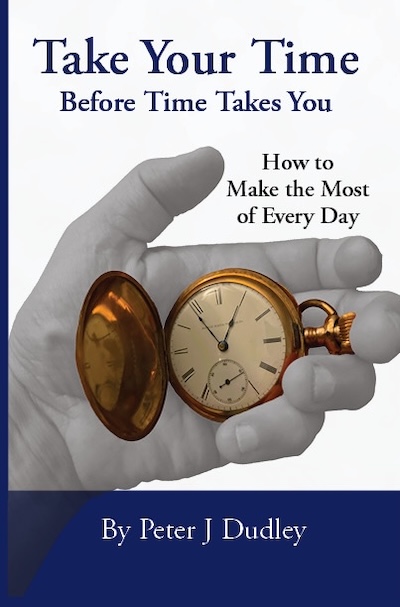
With Take Your Time Before Time Takes You, learn to make the most of every day through thought-provoking exercises and perspective-twisting stories. Get it now in paperback or ebook.
“It changed my life.” – TP, client
“A go-to guide for people who want to improve their lives but don’t know where to start.” – MJ, earlier reviewer

RELIT: How to Rekindle Yourself in the Darkness of Compassion Fatigue gives practical, actionable advice on avoiding and overcoming compassion fatigue and caregiver burnout. My chapter explains how I stay centered and focused so I can give every client my best, every time.
Download my chapter for free: Show up. Try hard. Be nice.
Or just go buy the whole book. It’s worth it.