You’re not as good at understanding people as you think
TL;DR: Families fall apart and workgroups disintegrate into dysfunction when people don’t understand the gap between predictions (expectations) and reality. We operate on a “Default Prediction Engine” driven by invisible cognitive and personal biases, like “green-tinted glasses” that you don’t even know you’re wearing. Even worse, Closeness-Communication Bias leads to autopilot (and wrong) assumptions about the people closest to you. To prevent relationship disintegration, people have to go from “default” to “active” prediction. They can do this by articulating their own worldview, recognizing others’ true strengths, and always asking what else could be true?
One reason I started coaching caregivers is that I kept seeing families fall apart from unforced, self-inflicted conflicts. They started out liking each other and ended up estranged or, worse, in court.
This is usually due to a long series of small, sliding steps down a slippery slope. It’s rarely caused by a single incident. The parties may point to a single incident, but that’s almost always the proverbial straw, not the root cause.
The root cause can usually be traced back to everyone believing their own expectations instead of acknowledging realities.
The Root Cause of Conflict: Expectation vs. Reality
We all have expectations for how things will go. What people will do, how others will interpret our own actions, how the world will work.
Some of those expectations are pretty solid. We can count on the fact that water will run downhill. When it doesn’t, that’s disruptive enough that we stop and examine why the reality of the situation conflicts with our expectations.
Our beliefs are based in a combination of bias and experience.
Experience tells us what to expect based on what has happened. We’ve seen water running downhill frequently, and we’ve never seen water running uphill. That consistency of experience creates an expectation that the consistency will persist into the future.
Bias comes in two flavors (at least for the purpose of this post).
Personal bias is the result of all your built-in perception filters. These come from your value system, your faith system, your family culture—your system settings that are both internal and external, and which define how you perceive the world.
Cognitive bias is a human tendency to apply different kinds of rules to any given situation in order to reduce the complexity of the world and make sense of what’s happening. Confirmation bias, for example, is the tendency to see evidence that supports your preconceived notions and ignore evidence that refutes them.
We all exist with both types of bias (personal and cognitive) constantly filtering and organizing the infinite complexity of the world into something we think we can understand.
Understanding Invisible Bias through a “Green Tinted Glasses” Metaphor
Did you know that 85% of Americans think they are less biased than the average person (the Illusory Superiority Bias at work)? I find this hilarious, but also curious and instructive. This information alone should give you pause the next time you think you are being objective and unbiased.
Biases are invisible to the person experiencing them. Imagine that at the moment of your birth you were given glasses that tinted everything slightly green. As you grew, you were made to wear similar green-tinted glasses that fit you, and you were NEVER allowed to take them off. You would develop a bias to see everything slightly green-tinted.

There’s no shame or judgment in that statement. You would have a green-tint bias, and it would not be a moral failing or character flaw. Also, you would be unaware you had this bias. It’s just how the world looks to you. Other people might notice your green-tint bias and even point it out to you, but you would demand that no, you do not have a green-tint bias because you have only ever experienced the world the way you have experienced it.
That’s how biases exist and are at the same time imperceptible to the person holding them.
Sometimes We’d Rather Die Than Change Our Beliefs
The same is true with cultural biases. The culture you grow up with—family, community, faith, etc.—creates perception filters like green-tinted glasses that you cannot take off… until you become aware that you are, in fact, wearing green-tinted glasses.
When you become aware of a bias you hold—one of your perception filters—taking off those green-tinted glasses can be incredibly disrupting to your identity. A lot of people put those glasses right back on and then criticize the rest of the world for not wearing green-tinted glasses.
That’s how powerful our own sense of identity is. Even when we become aware of a way we have been misperceiving things, we often cling to that misperception in order to protect our own ego rather than risk changing the identity we’ve had our whole lives. The book Good Reasonable People provides a deep dive into this idea.
This isn’t just a problem in social circles and work groups. Individual identity is such a strong human motivator that sometimes, we band together and go to war rather than change our deeply held beliefs.
Beliefs and Biases Drive How We Predict What Will Happen
Every day, we make predictions of what will happen, and then we make decisions based on those predictions.
A trivial example: “That car looks like it is going to slow down and make a left turn. I had better slow down so I don’t hit it.”
A more involved example: “If I tell my boss I need some time off to care for my mother, he will see me as weak and unreliable. So I had better just power through and… idk, drink more coffee?”
A family example: “My brother is such a flake. No way will he show up to help care for Dad. And even if he does, he’ll screw it up. I guess it’s time to quit my job and move across the country to make sure it all goes right.”
It’s not hard to identify the obvious biases and beliefs in these real-life statements. Those biases and beliefs led to a prediction, which then led to a conclusion steeped in other biases and beliefs.
Confidence and Accuracy Are Weakly Linked in Understanding Other People
People are way better at feeling confident they understand someone else, than in actually understanding that person. There’s very little correlation between how confident we are about our predictions, and how correct our predictions are.
This phenomenon is stronger with people we are close to. That is, we seriously overestimate how well we communicate with our family and friends. (Side note: That study used college students exclusively, which has been shown to be an incomplete way to extrapolate across all ages, as this Hidden Brain podcast discusses. More research should be done.)
This is known as closeness-communication bias. It’s thought to exist because the more comfortable we are in a situation (i.e. the more shared experience we have with someone), the more we drop into default mode when predicting what they will do. We listen less closely. We apply less critical thought. We wait for the blinker signaling a left turn instead of paying attention to all the available signals.
The Four Dangers of the Default Prediction Engine
This means that the more intimately we know someone, the more we go on autopilot with them. We turn on our default prediction engine. While this would seem to be more efficient, it has some major pitfalls that I see over and over and over, both in workgroups and in families:
- It doesn’t allow for change or growth
People change. People grow. When you engage your default prediction engine about someone, you’re failing to recognize changes they may have gone through. These changes can be dramatic (such as getting sober) or subtle (such as becoming less selfish). - It creates rifts and distance
When your default prediction engine gets it wrong (and it often does), the other person will feel unheard, unseen, and disrespected. When you do that over and over, they will probably withdraw or create barriers. They may stop taking your calls or returning your messages. - It limits change and growth
By its very nature, default mode stops any kind of innovation, creativity, or growth. You can’t change your thoughts about the other person if you’re not engaging your thought parts. The default parts execute without question; your thought parts need to activate if you are to grow or change at all. - It becomes self-fulfilling
Confirmation bias is strong. Every time your default prediction engine says “my brother will screw it up,” the rest of your brain will look for evidence that you made the right prediction and ignore evidence that you made the wrong prediction. Thus, you’ll feel vindicated, and you’ll confidently continue to make wrong predictions in the future.
Your default prediction engine is based on all the deeply held biases and beliefs that also define your identity. Therefore, it can’t possibly be wrong; if it were, you’d have to admit you were wearing green-tinted glasses. You might even have to take them off. And you can’t allow that to happen.
The end result is that families and relationships fall apart. Workgroups devolve into distrust and inefficiency. Social groups spin out into dysfunction, gossip, and resentment.
The Closer You Are, the More Attention You Have to Pay
I spend a lot of time thinking about people in high-power jobs suddenly taking over high-stakes caregiving roles. Our workshops and coaching help them flourish through caregiving while not unnecessarily sacrificing their jobs, their health, or their relationships.
Even experienced executives with loving families can end up quitting or scaling back their jobs, burning out, or watching their family relationships disintegrate as they try to juggle all these conflicting priorities.
There is no one simple prescription for making sure that doesn’t happen. And it’s not easy. But it is possible.
It starts with becoming aware that you are, in fact, wearing green-tinted glasses. This is not a moral failing or a character flaw. It’s just a fact. You have biases and beliefs that are imperceptible to you and which drive your default prediction engine.
Mindset Shifts: Breaking the Cycle of Default Predictions
Some of the things that we coach people through, and which will be part of the new small-group cohort we are putting together, are these mindset shifts:
- Get clear on your own core values and world view
The first step is to understand whether you’re wearing green-tinted glasses, blue-tinted glasses, or some other color tint. The more clearly you can articulate the truth of you, the easier you’ll be able to see the truth of others. - Understand how to recognize other people’s strengths
Everyone in your world has different strengths. Many caregivers fail because they try to plug the wrong people into the open gaps, then end up frustrated and angry when it doesn’t go well. When you empower people to do what they’re good at and fill the gaps in other ways, you end up far more successful. - Embrace the question “what else could be true?”
This is the key to activating your thinking parts and getting out of default prediction mode. Instead of asking am I being biased in this prediction, ask yourself what biases and beliefs are being activated right now? There are always some. They are not always wrong, but they are always there. - Communicate with clarity and power
Everyone I’ve heard say “I am a great communicator” has been a terrible communicator. Good communication takes attention, effort, skill, and practice. Busy people sometimes don’t slow down to communicate effectively, and miscommunication is the biggest creator of self-inflicted problems I know.
There’s so much more we work with clients on as well, from personal resilience to effective project management to proper prioritization to resource and asset allocation to much more.
Our first small-group cohort, the Flourishing Through Caregiving Working Group, will be in-person in Eugene, Oregon, beginning in July 2026. Click through that link to the web page to learn how to sign up.
We’ll be expanding from in-person to virtual groups in the future. If you’re interested in learning about those groups, drop me a line and we’ll keep you on our notification list.
Connect with me
Schedule a consultation session now or drop me a line.
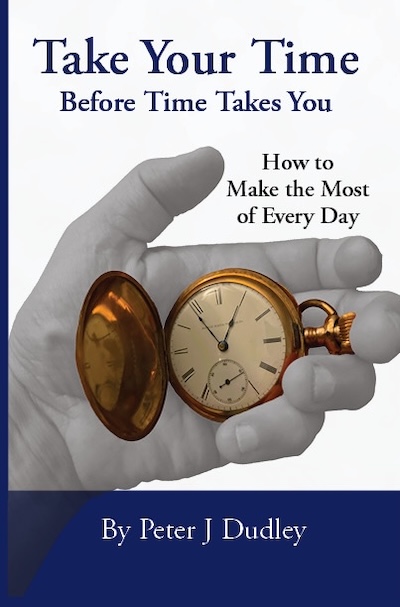
With Take Your Time Before Time Takes You, learn to make the most of every day through thought-provoking exercises and perspective-twisting stories. Get it now in paperback or ebook.
“It changed my life.” – TP, client
“A go-to guide for people who want to improve their lives but don’t know where to start.” – MJ, earlier reviewer

RELIT: How to Rekindle Yourself in the Darkness of Compassion Fatigue gives practical, actionable advice on avoiding and overcoming compassion fatigue and caregiver burnout. My chapter explains how I stay centered and focused so I can give every client my best, every time.
Download my chapter for free: Show up. Try hard. Be nice.
Or just go buy the whole book. It’s worth it.