The identity dissonance of reinventing yourself
TL;DR: Identity Dissonance is the psychological friction you feel when reinventing yourself causes you to hold two conflicting identities at the same time. Whether a transition is automatic (externally imposed, like caregiving) or intentional (like a self-driven career shift), dissonance occurs when nostalgia or people in your life act as identity bungee cords pulling you backwards. These three strategies help keep you moving forward: maintaining a clear future vision, curating digital environments to mute regressive inputs, and recognizing that nostalgia romanticizes past complexities.
I was feeling some identity dissonance this morning as I scrolled through LinkedIn. A former colleague’s post brought up a combination of nostalgia and repulsion. I clicked the “celebrate” reaction and scrolled on, but the weird feeling stuck with me.
What is Identity Dissonance? Defining the conflict of reinvention
Identity dissonance is a term I made up to describe what I’m feeling. If cognitive dissonance is the psychological conflict of holding two opposing beliefs at the same time, then identity dissonance is the emotional squidginess of holding two conflicting identities at the same time.
This can happen when you reinvent yourself or go through some other kind of identity transition, including identity creep or falling off the identity cliff.
I’ve reinvented myself several times throughout my life. Reinvention happens intentionally or automatically.
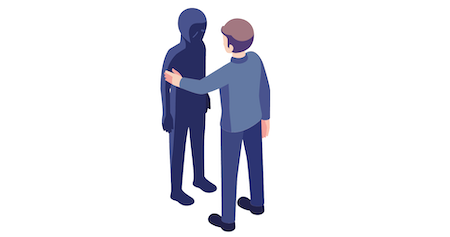
Edited stock art (source)
Automatic vs. intentional reinvention: how shifts occur
Automatic reinvention looks like changing a state of life, like transitioning from being someone’s child to being an independent adult, or like graduating high school and going from student to worker. Or becoming an empty nester, or becoming a caregiver. These are externally driven shifts that you respond to by adjusting your identity appropriately.
Intentional reinvention looks like major career shift, or going back to school for a different degree, or becoming a parent for the first time, or getting divorced. Major changes to your life that you choose, which then precipitate or require a shift in identity as well.
People with greater ego fluidity (“I can be whoever I want to be”) navigate these identity shifts with more ease and less friction. People with more ego rigidity (“I am this way and always will be”) experience more conflict and tension during these reinvention times.
In both cases, a reinvention whether automatic or intentional will, by definition, require an identity shift. It may be dramatic, such as someone taking a civilian job after a long military career. Or it may be subtle, such as going from being a parent of three kids to a parent of four kids (which means a car with six seatbelts, which might mean a minivan is now part of your personal brand).
Whether the reinvention is intentional or automatic, your level of identity dissonance will be driven by how tightly you cling to the previous identity.
Identity dissonance creates vague but real inner conflict
The inner conflict of identity dissonance is real. Part of you is struggling to stay the old thing, and part of you is struggling to become the new thing. This can keep coming up again and again, even well after the reinvention seems complete.
When I saw my former colleague’s post this morning, the identity I left behind a decade ago woke up and started taking up space in my psyche. “You miss that work,” it told me. “We miss those people. Wasn’t that a great time? Wasn’t that a meaningful role? We were kind of a rock star back then!”
Those feelings were not wrong, but they were immediately countered by the parts of me that demanded I reinvent myself ten years ago. “Yeah, but the workplace turned toxic. The work itself is filled with contradictions and isn’t as impactful as it pretends to be. Isn’t it kind of sad that so many of the people who were doing that work back then are still doing it today? Nothing has changed for them. But look how much we’ve grown and changed!”
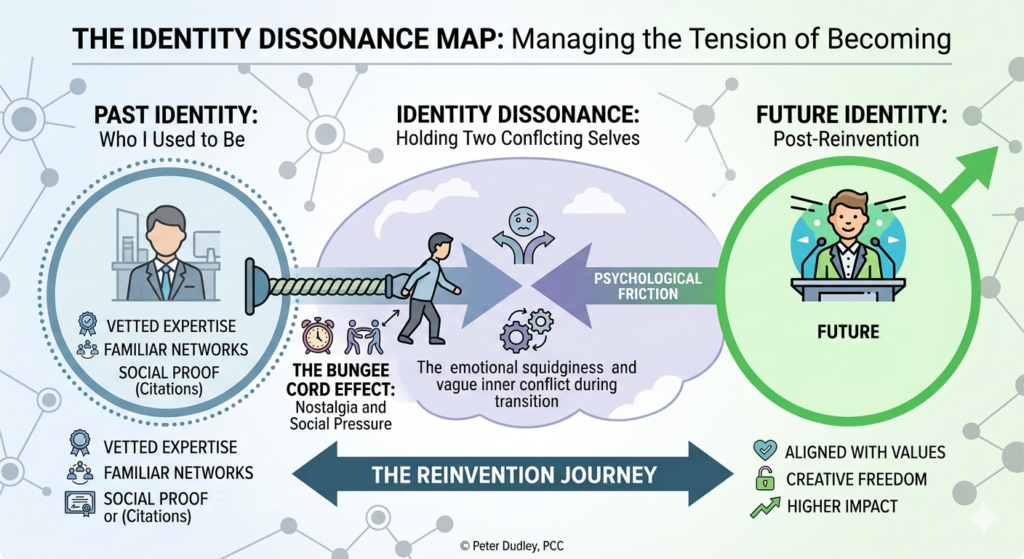
(This image was generated by Gemini and cleaned up by me.)
The bungee cord effect: how social networks hinder growth
As my experience and this Psychology Today article illustrates, identity dissonance may not just be an internal thing.
When other people do and say things that reinforce their perception of you as the old identity, the pre-reinvention you, then it becomes harder for you to separate from that old identity.
This is what happens a lot with me on LinkedIn. I want to maintain connections with my old colleagues, especially those people I really genuinely liked, respected, and admired. But their relationship was with pre-reinvention me, so when they show up in my feed, it’s like a psychological bungee cord pulling me back to that prior time.
But I don’t want to just cut all that off. I don’t want to sever those connections. And I can’t just reeducate those people to my new identity because they’re not doing anything other than existing an posting their own updates. It’s my own internal conflict.
3 strategies for managing identity dissonance and ego fluidity
Sometimes you do just have to let go. Many divorces, for example, lead to having to let go of some valued friendships. It’s sometimes better for everyone to sever those connections. Same with some toxic situations.
If you want to maintain connections while reinventing yourself, however, then you have to take ownership of managing your own identity dissonance. Don’t expect the world to change around you just because you decided to change.
Here are three things you can do to stay on the path forward while maintaining some regressive connections:
- Keep your future vision clear and at hand
You decided to reinvent yourself. There were reasons why you decided to point yourself in this new direction. Write down those reasons, or find some other way to represent them like a photo collage. Keep your aspirations and your inspiration close at hand so it’s easy to reconnect to the vision when times get hard or the bungee starts pulling you backwards. When you review these vision items, take a few deep breaths (inhale for three seconds, exhale for seven seconds), then close your eyes and focus your attention on your solar plexus for ten seconds. Do this as many times as it takes to clear your mindset. - Curate your environment to support the new identity
If you find that certain things keep hooking you and pulling you backwards, do your best to mute those things or set them out of your daily life. On LinkedIn, for example, you can unfollow a person without severing your connection. You can always go and look at their profile and posts when it suits you. Pay attention to the things that cause you to feel the nostalgia for your prior identity. Whenever you see a pattern, try to find a way to mute that input. - Remember that nostalgia is a liar
Both nostalgia and regret are highly effective liars. Nostalgia over-romanticizes a time that was more complex and troubled than you remember. Regret zooms in on isolated events in the past to blot out the good that exists today. When you feel identity dissonance, very likely nostalgia has joined the party and is taking over the conversation. Balance that out by revisiting the actual facts from that time, both the good and the bad.
Supporting others: Don’t be someone else’s bungee cord
One final thought on identity dissonance and reinvention.
Whenever we reinvent ourselves, we want everyone around us to honor that reinvention and treat us as the person we are becoming. We don’t want them to cling to their old version of us.
So when other people go through a reinvention of their own, don’t be the bungee cord that keeps dragging them back to a version of them that you’re comfortable with. Allow them to change. Figure out how to support that change.
Connect with me
Schedule a consultation session or sales call now, or drop me a line.
With Take Your Time Before Time Takes You, learn to make the most of every day through thought-provoking exercises and perspective-twisting stories. Get it now in paperback or ebook.
“It changed my life.” – TP, client
“A go-to guide for people who want to improve their lives but don’t know where to start.” – MJ, earlier reviewer