Why AI will replace many coaches (but not me)
No one actually needs a coach to get from Point A to Point B, just like no one needs a mechanic to fix their car. I promise, you can absolutely get from Point A to Point B on your own.
But this has been true since forever. People found their way, started businesses, and had rewarding lives before coaching became a recognized vocation.
The reason super-successful luminaries like Eric Schmidt say everyone needs a coach is that a coach helps you get from Point A to Point B more efficiently, with fewer mistakes and u-turns and failures along the way.
AI gives you a new option
Now that AI is here, there are four ways you can go from Point A to Point B:
- Do it on your own
You might read a book or ask friends for advice, but essentially, you’re doing this on your own. - Use AI as your coach
AI can do many things really well, especially validate whatever worldview you bring to it. Still, you can use AI as your “coach” to help you through a lot of low-stakes decisions. - Work with a good coach
A good coach in my definition is a professional coach with some training and coaching experience. Perhaps a certification or two. - Work with an elite coach
An elite coach has broad lived and professional experience as well as a wide range of skills, models, and approaches. They go beyond normal coaching to include deep internal alignment, how systems succeed and fail, creating action plans, and transforming cultures of organizations and groups. They challenge, advise, think strategically, and get closer to truth.
All four of those are viable options for any situation. (If you are wondering why I did not include “Work with a bad coach,” you may need more help than a coach can provide.)
Why get help at all?
Option 1, doing it on your own, is the hardest of the four. Getting help and guidance from AI, a good coach, or an elite coach is likely to have a better result in several dimensions:
- Time to goal
If it would take you a certain amount of time on your own, working with a coach will get you there faster (or more efficiently, with less expense or effort… some version of “faster” that matches the situation). This is a productivity measurement. - Mistakes, wrong turns, and failures
Coaching will reduce the mistakes and failures, keeping you more consistently pointed at your goal. This is an accuracy measurement. - Suffering
Coaching will reduce the amount of stress, anxiety, and struggle you feel along the way. This is a quality measurement. - Loneliness and isolation
Having a neutral third party in your corner, dedicated to your success, makes the journey less lonely. This is an engagement measurement.
I asked AI to help me figure it out
To affirm or refute my assessment, I asked Claude to do some research, both in executive/business coaching and life transition/caregiver coaching. I gave it the four dimensions above and asked it to scour existing literature, studies, popular opinion, and any other research it could find.
I believed that in all four dimensions, AI would help a little, a good coach would help more, and an elite coach would help the most. I made my own guesses at how much difference each would make. I didn’t share my guesses with Claude because I didn’t want Claude to just confirm my belief. My guesses turned out to be pretty close to what Claude returned, with one glaring exception.
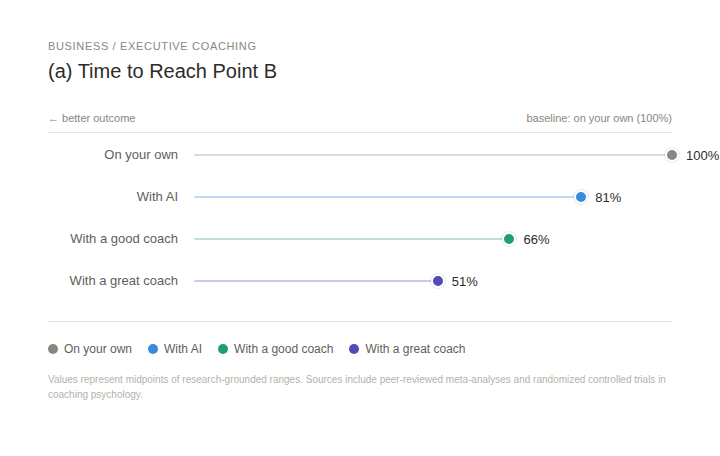
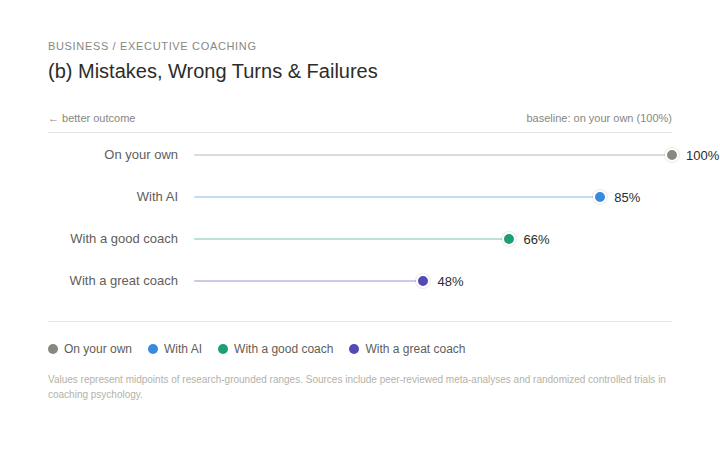
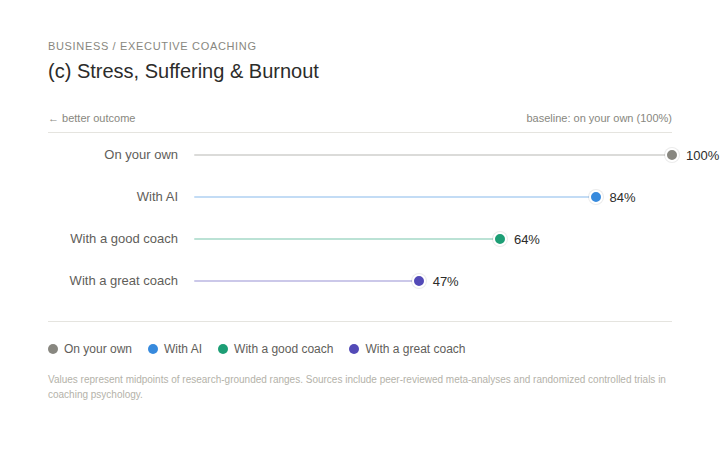
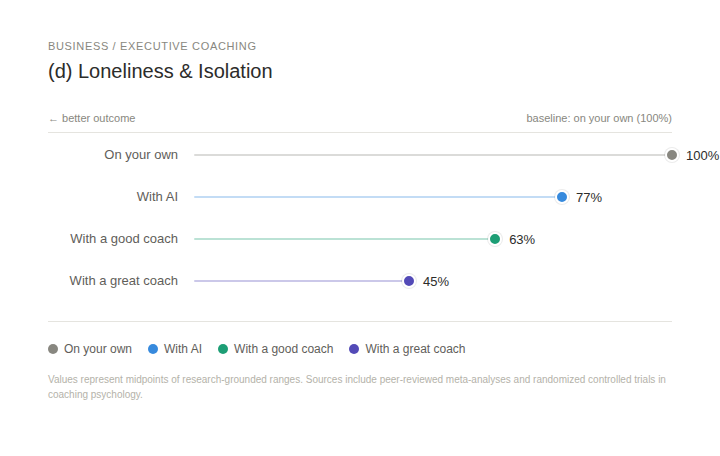
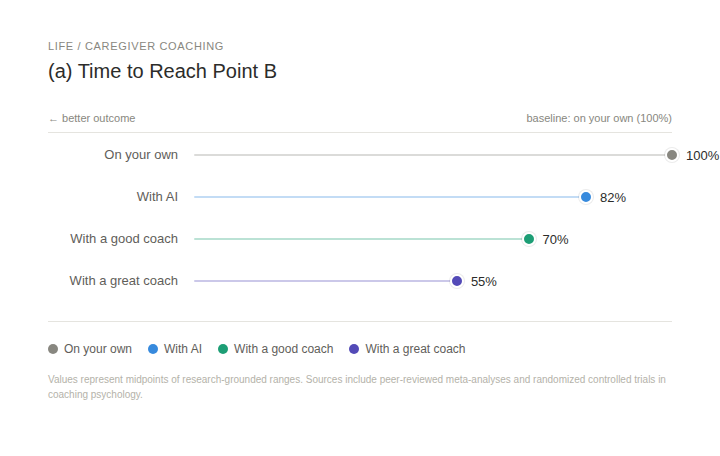
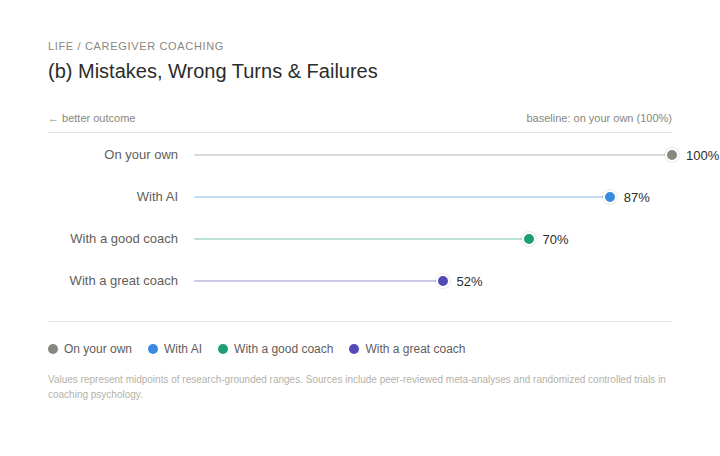
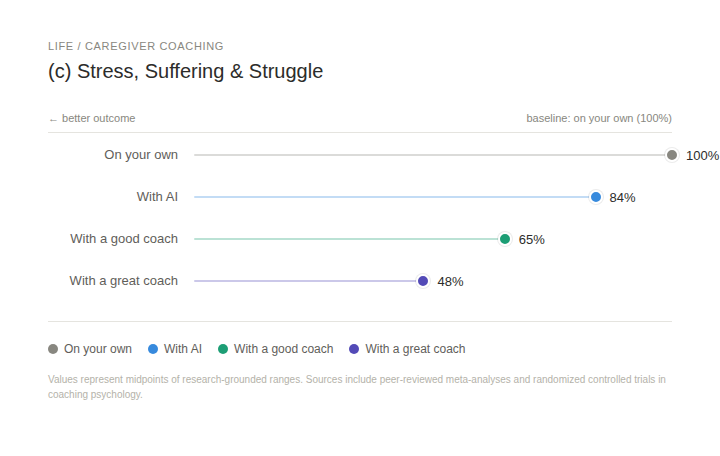
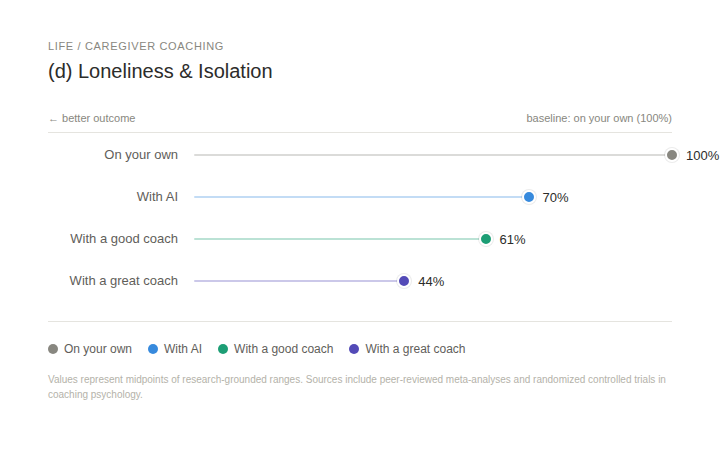
“Do it yourself” was the baseline. I asked Claude to consider “do it yourself” as 100%, then assign numbers based on the value added by the help. For example, if it would take you 100% time to get to Point B on your own, AI might help you get there in 90% of the time. A good coach, 75%. An elite coach, 50%.
TL;DR: I was right. In all cases, AI would help a bit, a good coach a bit more, and an elite coach significantly more.
Caveat: The results are not what I would call “rigorous science.” They are directionally supported by several studies and much published evidence, but at this high level and on these metrics there are few definitive conclusions. I have the list of Claude’s sources and citations if you would like to see it or dig deeper into any of this. Even Claude gave the caveat that the results are “research-grounded anchors,” not precise conclusions. Also, the charts below show the midpoints of the ranges that Claude’s research came back with, for simplicity of illustration. I am okay with that simplification because none of the ranges overlapped, so the midpoints accurately represent relative amplitude.
Business/Executive Coaching
Business leaders from the C Suite to front line management show dramatically increased effectiveness when they get coaching on a regular basis.
I help leaders get the most from themselves and their teams. Having been in the C Suite, and having been a senior executive running global programs for hundreds of thousands of employees, and having raised a half billion dollars for charity, I know a thing or two about leadership. These days, I focus on coaching nonprofit executives, who have one of the hardest, most complicated, and least understood jobs in business.
Time to Goal (Productivity Measurement)
The literature focuses more on productivity than time to completion, so Claude compared “how much work gets done in a time period” instead of true time to goal. In addition, Claude noted that various studies show these benefits of coaching:
- One-on-one coaching for eight weeks improved leader effectiveness 4x after attending a training
- Coaching accelerates development of trust, strategic clarity, and cultural fluency
- Leader coaching improves team productivity, efficiency, decision-making, and error rate
Mistakes, Wrong Turns, and Failures
Claude cites studies from ICF and others showing the business ROI of coaching in terms of leadership effectiveness, goal attainment, and employee engagement. More than 25% of clients surveyed reported a ROI of 10x to 49x the cost of the coaching. That is, if coaching cost $10,000, the return was estimated at $100,000 to $490,000 (and even higher in some cases).
Suffering
Even though most business and executive coaching focuses on problem-solving and workable actions, the research shows that clients also enjoyed improved resilience and workplace well-being, greater adaptability, and reduced depression. In addition, research confirms a 32% improvement in employee engagement under leaders who are being coached. This is an area where an elite coach’s rich domain expertise can provide significant extra value.
Loneliness and Isolation
Most people will scoff to hear it, but CEO is often a lonely, isolated role. One study found that more than half of CEOs struggle with loneliness that negatively affects their performance. CEOs that have some sort of structured peer support report dramatically improved company performance. Further research shows that while AI can deliver meaningful “feeling heard” effects, what leaders really need is a peer, not just a listener with off-the-shelf advice. An elite coach can be that peer, even for someone like the CEO of Google.
Life Transition/Caregiver Coaching
A lot of life coaching is very low stakes: using time effectively, contemplating life direction, and general wellness and well-being. I don’t see much point to hiring a coach for this; AI will help you pretty well. The type of life coaching that interests me is high stakes—caregiving, life transition, marriage/divorce, the kinds of things that irrevocably change your identity. Those are the areas where an elite coach who has been through some shit can make an enormous difference. AI cannot feel the loss of a loved one. It cannot understand the joy of a new baby. AI cannot face its own mortality, cannot feel gender dysmorphia, cannot suffer assault or abuse. It cannot be human.
I help people who are at the height of their career and are suddenly burdened with a caregiving obligation (aging parent, spouse with cancer, etc.) or who need to make a big life transition (career pivot, divorce, empty nest, etc.). People who have a lot at stake and want to make sure they get it right. People who want a future with stability, fulfillment, purpose, and strong relationships. I’ve not only coached more than 300 people in the past few years, but I teach other coaches and have led dozens of workshops in this area. I even published a book on it. So I’ve seen the effectiveness of coaching up close and personal.
Time to Goal
Simply having someone who is paying attention to your progress has been shown to improve goal success dramatically. That can be a friend, a coach, or a chatbot. One landmark study found that both human and chatbot coaches significantly improved goal achievement over a 10-month period compared to control groups. In this study, human coaching also consistently outperformed the AI coached group.
Mistakes, Wrong Turns, and Failures
There is no clean research that shows how coaching affects mistakes made, though the available research strongly supports the idea that coaching helps people achieve their goals more effectively than self-directed activity. Claude didn’t tell me this, but my own experience shows me that the reason there are so many self-help books is that people buy them and then fail to do what the books say. I also have had a lot of clients come to me having “tried” to make a certain change many times, but never been able to do it. Those represent the wrong turns, mistakes, and failures that never get measured or reported. One data point Claude did find is that when selecting a coach, you should look for someone who is consistently working on their own professional development; longevity in coaching alone seemed to have no correlation with quality, but a focus on lifetime learning did. This is one distinction between good coaches and great coaches.
Suffering
There’s actually quite a bit of good research that concludes that life coaching decreases stress, reduces depression, and improves overall well-being. AI is shown to help in this area through well known tools and methods. AI does not replace human connection in high-stakes situations, however… and can even get it drastically wrong. So, having a human coach to guide you will make the journey to Point B a lot more pleasant and less stressful.
Loneliness and Isolation
There’s no doubt that having someone who listens deeply to you will reduce feelings of isolation and loneliness. AI performs surprisingly well in this area. Much better than my guess, in fact. I guessed that AI would have little to no effect on loneliness, but it has been shown to give people feelings of validation and companionship. So, actually, there’s not much difference between an AI and a good coach in this area—in some cases, no difference at all. There is, however, a big difference between AI and a great coach here. Claude posits that this may be because an AI or good coach may provide listening, sympathy, and validation, but a truly great coach will cultivate feelings of belonging, agency, and intimacy.
How much is that worth?
The other day, a young woman looking to make a career change told me she had bought the book Design Your Life. Her plan is to work through that book, maybe with the help of AI, to figure herself out and decide what she wants from her career. (I have my own version of that kind of book, by the way.)
For her, that decision makes a ton of sense. She has access to free coaching through her work’s EAP program. (In my experience, that’s generally mediocre-to-good coaching, with the occasional gem.) So why would she hire an elite coach when she’s got a low-stakes problem and resources that can help make it easier? Sure, it’s her career, but she’s young with plenty of time to course correct. She can absorb a few mistakes and wrong turns.
I encouraged her to get creative about using AI to help her on that path. And if it wasn’t working out, she could always come back to me.
How much is that worth to you?
What change do you need to make in your life? What high-stakes problem or decision do you need to resolve? How fulfilled do you want to be during whatever time you have left?
What if you could get there 40% more efficiently, with half the mistakes and half the anxiety and stress, accompanied by an experienced pro who is completely dedicated to your success?
It’s a pretty straightforward calculation when you look at these charts. Should be a no-brainer in most cases. If you’re just dabbling in change or have something small to improve, start with AI. But if it’s something you actually care about? Invest in your own success.
Where is the coaching industry going?
You may have noticed that there’s not much gap between an AI chatbot and a good human coach. That gap will continue to shrink as AI tools mature. This would seem like bad news for the coaching industry.
Coaching has enjoyed a boom in the 2020s. More people have gone into coaching. An ICF study showed that the number of practitioners grew 15% from 2023 to 2025 alone. EAP programs are including coaching as a “mental health” service as a checkbox benefit.
All this has made basic coaching available at a mass market level—cheaper, more affordable, and transactional in nature. It’s a lowest common denominator approach, helping a lot of people incrementally in small ways. It’s assembly line mass production at scale.
But, like timeshares through the early 2000s, supply has been overbuilt. Worse, this buildup has occurred just as AI has shaken everything up.
The effect? Downward pressure on price, homogenization of product at scale. More noise in the system making the value proposition confusing and diluted. Basic self-help coaching and formulaic business coaching is becoming virtually free through AI chatbots.
This will bring basic coaching to more people—those who aren’t paying for it now will finally have access. Mediocre coaches will struggle. Good coaches will be squeezed. This is already happening due to the oversupply problem, and AI will accelerate this trend.
At the high end, where AI cannot compete, demand will remain strong and may even grow. Areas such as identity work, organizational politics, transformation under ambiguity, and high-stakes relational dynamics. And that is where I do my best and most impactful work.
Which is why AI will replace many coaches. But not me.
RELIT ebook free through April (extended!)
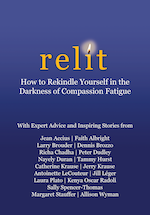
To get a free ebook of RELIT during the month of April 2026, download it from my web shop using the coupon code MakeBooksNotWar.
Connect with me
Schedule a consultation session or sales call now, or drop me a line.
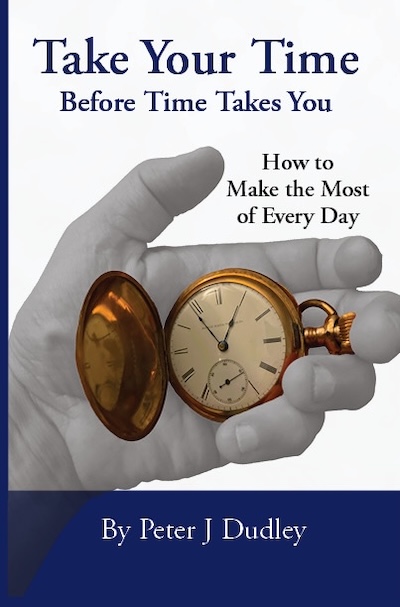
With Take Your Time Before Time Takes You, learn to make the most of every day through thought-provoking exercises and perspective-twisting stories. Get it now in paperback or ebook.
“It changed my life.” – TP, client
“A go-to guide for people who want to improve their lives but don’t know where to start.” – MJ, earlier reviewer