Stop being so judgy
In studies, 85% of Americans think they are less biased than average. While this is not mathematically impossible1, I think it’s both funny and entirely predictable.
The vast majority of people (85%!) think they are highly objective. More objective, in fact, than half the population.

The truth is, of course, that most bias is invisible to the person who holds the bias. This is something I remind my clients of when I first start working with them—I’ve identified a lot of my own inherent and chosen biases, but I’m still identifying the ones I haven’t discovered yet. So, if my clients ever feel I am coloring our conversation with my own biases, I want them to call me out.
I am, for example, biased toward an empathetic, vulnerable, and collaborative leadership style. I choose a bias toward skepticism over belief. I strive for biases that lean me toward inclusion, curiosity, and flexibility.
I also carry biases that I would not like to admit out loud. I actively work to recognize when these biases are coloring my view of a person, organization, or system, and then try to nudge myself out of bias and into objectivity. For example, I view wealth inequity as injustice, so I tend not to trust people who have too much wealth or who seem accumulation-oriented. I am not a fan of how organized religion has shaped society over the centuries, so I tend to avoid things and people closely affiliated with organized religion. My memories are stronger when I can imagine a visual or spatial aspect of the event rather than activities, meals, or conversation.
Then there are other biases that everyone experiences whether they know it or not. Some of my favorites are confirmation bias (the tendency to overvalue evidence that supports preconceived ideas and undervalue evidence that refutes them), selection bias and sampling bias (limiting the input set in such a way that it creates incomplete output), the false consensus effect (believing most people think the same way you do), and the Dunning-Kruger effect (the tendency to overvalue your skills when you’re bad at something, and to undervalue your skills when you’re good at something).
Being judgy
When I sat down to write this post today, I was thinking about the ways in which we are judgmental of other people. I had just gotten off a call with a client who wants to be less judgmental of the people in her life. She doesn’t want to go through her days constantly disappointed, let down, and resentful. It’s a complex topic in a complex social dynamic.

After that call, I was thinking about how reducing judgment of others begins with being less judgmental of yourself. In doing a little research, I found that while this is a widely held belief among people who study these things, there is no accepted, reliable, repeatable proof of causality between increasing self-compassion and a resulting increase in compassion for others.
That is, having more compassion for yourself does not automatically lead to greater compassion for others.
I think that’s largely due to the fact that nearly everyone thinks they’re less biased than other people are. That is, if you think you are highly objective and other people are biased, building self-compassion creates an internal bridge but not an external bridge.
Self-acceptance and self-development
In practice, reducing your own self-judgment may look like indulging your own biases (self-acceptance), but reducing your judgment of others may look like challenging your biases (self-development). Both are important, but they may not be as closely tied together as I had thought.
A lot of the people I coach are trying to find a balance between self-acceptance and self-development. It’s important to be happy with who you are, but it’s also important to keep learning and growing. Both are possible at the same time, especially as you become self-aware on a deeper level. That means exposing, acknowledging, and understanding our own biases.
Bias is not inherently bad… but it can be weaponized
None of us wants to feel like we’re biased. (Oops, just engaged in a little false consensus effect there, didn’t I? Let me try again.)
Being labeled as biased tends to carry a negative stigma. Merriam-Webster lists prejudice as the first synonym of bias, and the word prejudice is bandied around as a pejorative. Most of us aren’t eager to be labeled as prejudiced, and we don’t want to appear biased… even though we are.
Bias itself is not inherently bad. It is simply a leaning one way or another.
Unrecognized and hidden bias can lead to friction and tension. It can lead to incorrect assumptions and miscommunication, which can cause relationships to fall apart.
Weaponizing bias leads to conflict. Demagogues understand this and can manipulate entire populations by exploiting both hidden biases and open prejudice. And because 85% of people think they are more objective than average, they are even more prone to manipulation.
The flip side is also true. It’s far too easy to dismiss someone else if you aren’t aware of your own biases.
“Well, you’re just biased” is a convenient way to shut down an argument and claim victory through forfeit. Obviously, you can’t help a biased person see reason.
And if they disagree with you, then obviously they are not seeing reason because you are far more objective than the average person.
Aren’t you?

- Average and median are different things. It’s possible for 85% of a set to be smaller than average if there is a small number of extremely large items in the set, for example. Median, however, is the item that sits in the middle of the set. So, by definition it is impossible for 85% to be on one side of the median, but it is possible for 85% to be on one side of the average. ↩︎
Connect with me
Schedule a consultation session now or drop me a line.
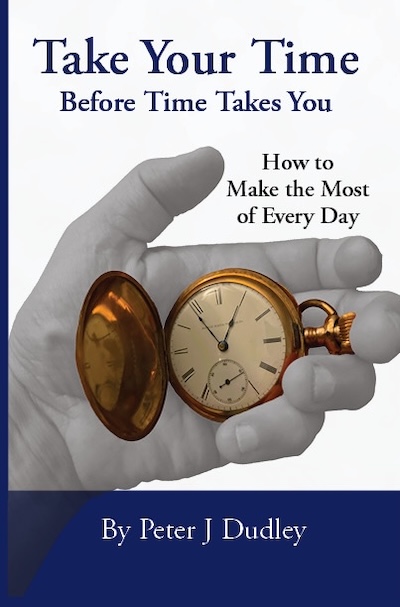
With Take Your Time Before Time Takes You, learn to make the most of every day through thought-provoking exercises and perspective-twisting stories. Get it now in paperback or ebook.
“It changed my life.” – TP, client
“A go-to guide for people who want to improve their lives but don’t know where to start.” – MJ, earlier reviewer

RELIT: How to Rekindle Yourself in the Darkness of Compassion Fatigue gives practical, actionable advice on avoiding and overcoming compassion fatigue and caregiver burnout. My chapter explains how I stay centered and focused so I can give every client my best, every time.
Download my chapter for free: Show up. Try hard. Be nice.
Or just go buy the whole book. It’s worth it.